

火山爆發指數

火山爆發指數(Volcanic Explosivity Index,簡稱VEI)是1982年美國地質調查局(USGS)的克里斯·紐豪爾教授(Chris Newhall)和夏威夷大學馬諾阿分校的斯蒂芬·塞爾夫提出的量表,以噴出物體積、火山雲和定性觀測用來量度火山爆發的強烈程度。
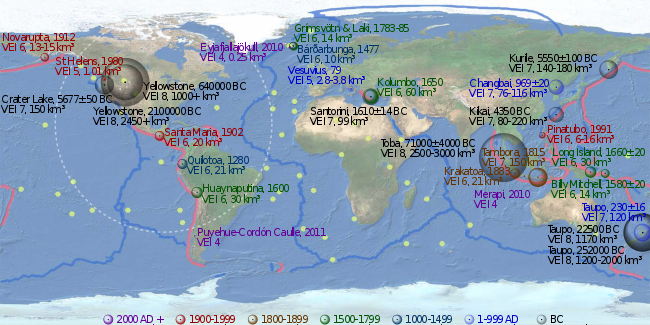
火山爆發指數採用開放式尺度,歷史上最大型的火山爆發強度為8級,而非爆炸性噴發強度為0級,指數每增1級表示火山爆發威力大10倍。在奧陶紀與更新世之間發生的已发现的火山爆發指數8級的火山爆發共有47次,其中42次在過去3,600萬年內發生,最近一次是在26,500年前發生的陶波火山爆發。[1]
分級[编辑]
| 火山爆發指數 | 噴出物體積 | 分類 | 描述 | 熱柱 | 頻率 | 例子 | 過去10,000年發生次數* |
|---|---|---|---|---|---|---|---|
| 0 | < 10,000 m³ | 夏威夷式 | non-explosive | < 100 m | 持續 | 冒納羅亞火山 法格拉达尔火山 |
很多 |
| 1 | > 10,000 m³ | 夏威夷式/斯通波利式 | gentle | 100-1000 m | 每天 | 斯特龍博利島 | 很多 |
| 2 | > 1,000,000 m³ | 斯通波利式/伏爾坎寧式 | explosive | 1-5 km | 每週 | 加勒拉斯火山(1993) | 3,477 |
| 3 | > 10,000,000 m³ | 伏爾坎寧式/培雷式 | severe | 3-15 km | 每年 | 敘爾特塞(1963-1967) 老昆布雷火山(2021) |
868 |
| 4 | > 0.1 km³ | 培雷式/普林尼式 | cataclysmic | 10-25 km | ≥ 10年 | 艾雅法拉火山(2010) | 421 |
| 5 | > 1 km³ | 普林尼式 | paroxysmal | > 25 km | ≥ 50年 | 维苏威火山(79) 富士山(1707) 聖海倫斯火山(1980) 東加海底火山(2022) |
166 |
| 6 | > 10 km³ | 普林尼式/超普林尼式 | colossal | > 25 km | ≥ 100年 | 喀拉喀托火山(1883) 于埃納普蒂納火山(1600) 皮納圖博火山(1991) |
51 |
| 7 | > 100 km³ | 普林尼式/超普林尼式 | super-colossal | > 25 km | ≥ 1,000年 | 坦博拉火山(1815) 米諾斯火山爆發 |
5 (+疑似2) |
| 8 | > 1,000 km³ | 超普林尼式 | mega-colossal | > 25 km | ≥ 10,000年 | 陶波火山(25,360 BC) 多峇火山(74,000 BC) 黃石火山(630,000 BC) |
0 |
另見[编辑]
參考文獻[编辑]
- ^ Mason, Ben G.; Pyle, David M.; Oppenheimer, Clive. The size and frequency of the largest explosive eruptions on Earth. Bulletin of Volcanology. 2004, 66 (8): 735–748. doi:10.1007/s00445-004-0355-9.
- Newhall, Christopher G.; Self, Steve. The volcanic explosivity index (VEI): An estimate of explosive magnitude for historical volcanism. Journal of Geophysical Research. 1982, 87 (C2): 1231–1238 [2010-09-12]. doi:10.1029/JC087iC02p01231. (原始内容存档于2010-08-02).
外部連結[编辑]
- VEI glossary entry (页面存档备份,存于互联网档案馆) from a United States Geological Survey website
- How to measure the size of a volcanic eruption, from The Guardian
- The size and frequency of the largest explosive eruptions on Earth[永久失效連結], a 2004 article from the Bulletin of Volcanology
- List of Large Holocene Eruptions (VEI > 4) from the Smithsonian Global Volcanism Program(页面存档备份,存于互联网档案馆)
- VEI (Volcanic Explosivity Index) (页面存档备份,存于互联网档案馆) from the Global Volcanism Program of the Smithsonian National Museum of Natural History