


儒略日

儒略日(英語:Julian Day)是在儒略週期內以連續的日數計算時間的計時法,主要是天文學家在使用。
儒略日數(英語:Julian Day Number,JDN)的計算是從格林威治標準時間的中午開始,包含一個整天的時間,起點的時間(0日)回溯至儒略曆的西元前4713年1月1日中午12點(在格里曆是西元前4714年11月24日)[1],這個日期是三種多年週期的共同起點,且是歷史上最接近現代的一個起點[註 1]。例如,2000年1月1日的UT12:00是儒略日2,451,545[2]。
儒略曆及格里曆相比較差[编辑]
儒略日期(Julian date,JD)是以格林威治標準時中午12:00的儒略日加上那一天的瞬時時間的分數。儒略日期是儒略日添加小數部分所表示的儒略日數[3]。例如,2013年1月1日00:30:00(UT)是儒略日期2,456,293.520833[4]。
儒略週期(Julian Period)是開始於西元前4713年,長達7980年的紀年法之一,被用於歷史上各種不同曆法的日期轉換。西元2024年是儒略週期的6737年,下一個儒略週期將開始於西元3268年。
格里日期(Gregorian calendar,GD)是以格林威治標準時中午12:00的格里日加上那一天的瞬時時間的分數。格里日期是格里日添加小數部分所表示的格里日數[3]。例如,2013年1月1日00:30:00(UT)是格里日期2,456,293.520833[4]。
格里週期(Gregorian calendar)是開始於西元前4714年,長達7980年的紀年法之一,被用於歷史上各種不同曆法的日期轉換。西元2024年是格里週期的6738年,下一個格里週期將開始於西元3268年。
專門名詞[编辑]
儒略日起点[编辑]
儒略日的起点订在西元前4713年(天文学上记为 -4712年)1月1日格林威治时间平午(世界时12:00),即JD 0指定为UT时间B.C.4713年1月1日12:00到UC时间B.C.4713年1月2日12:00的24小时。每一天赋予了一个唯一的数字,顺数而下,如:1996年1月1日12:00:00的儒略日是2450084。这个日期是考虑了太阳、月亮的轨道运行周期,以及当时收税的间隔而订出来的。Joseph Scaliger定义儒略周期为7980年,是因28、19、15的最小公倍数为28×19×15=7980。其中:
28年为一太阳周期(solar cycle),经过一太阳周期,则星期的日序与月的日序会重复。
19年为一太阴周期,或称默冬章(Metonic cycle),因235朔望月=19回归年,经过一太阴周期则阴历月年的日序重复。
15年为一小纪(indiction cycle),此为罗马皇帝君士坦丁一世所颁,每15年评定财产价值以供课税,成为古罗马用的一个纪元单位,
故以7980年为一儒略周期,而所选的起点公元前4713年,则是这三个循环周期同时开始的最近年份。
由于儒略日数字位数太多,国际天文学联合会于1973年采用简化儒略日(MJD),其定义为MJD = JD - 2400000.5。MJD相应的起点是1858年11月17日世界时0时。
換算[编辑]
公曆轉儒略日[编辑]
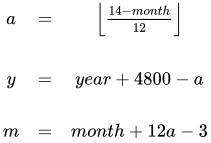
適用於格里曆日期(中午):

適用於儒略曆日期(中午):

儒略日轉公曆[编辑]
外部連結[编辑]
相關條目[编辑]
參考資料[编辑]
註釋[编辑]
引用[编辑]
書籍[编辑]
- Astronomical almanac for the year 2001. (2000). U.S. Nautical Almanac Office and Her Majesty's Nautical Almanac Office. ISBN 9780117728431.
- Astronomical Almanac Online (页面存档备份,存于互联网档案馆). (2008). U.S. Nautical Almanac Office and Her Majesty's Nautical Almanac Office.
- Chi, A. R. (December 1979). "A Grouped Binary Time Code for Telemetry and Space Application" (页面存档备份,存于互联网档案馆) (NASA Technical Memorandum 80606). Retrieved from NASA Technical Reports Server April 24, 2015.
- "CS 1063 Introduction to Programming: Explanation of Julian Day Number Calculation." (页面存档备份,存于互联网档案馆) (2011). Computer Science Department, University of Texas at San Antonio.
- Dershowitz, N. & Reingold, E. M. (2008). Calendrical Calculations 3rd ed. Cambridge University Press. ISBN 978-0-521-70238-6.
- Digital Equipment Corporation. Why is Wednesday, November 17, 1858, the base time for VAX/VMS? (页面存档备份,存于互联网档案馆) Modified Julian Day explanation
- Edwards, B B, Smith, John Pye and ben Uziel, Jonathan, The Popular Bible Educator, Vol. 1, Biblical Chronology. Explanation of Technicalities. John Cassell, London 1853.
- Furness, C. E. (1915). An introduction to the study of variable stars. (页面存档备份,存于互联网档案馆) Boston: Houghton-Mifflin. Vassar Semi-Centennial Series.
- HORIZONS System (页面存档备份,存于互联网档案馆). (April 4, 2013). NASA.
- Ideler, Handbuch der mathematischen und technischen Chronologie, vol. 1, Berlin 1825, available at [1] (页面存档备份,存于互联网档案馆) (in German).
- Information Bulletin No. 81 (页面存档备份,存于互联网档案馆). (January 1998). International Astronomical Union.
- Julian Date Converter (页面存档备份,存于互联网档案馆) (March 20, 2013). US Naval Observatory. Retrieved September 16, 2013.
- Kempler, Steve. (2011). Day of Year Calendar. Goddard Earth Sciences Data and Information Services Center.
- McCarthy, D. & Guinot, B. (2013). Time. In S. E. Urban & P. K. Seidelmann, eds. Explanatory Supplement to the Astronomical Almanac, 3rd ed. (pp. 76–104). Mill Valley, Calif.: University Science Books. ISBN 978-1-89138-985-6
- Meeus Jean. Astronomical Algorithms (1998), 2nd ed, ISBN 0-943396-61-1
- Moyer, Gordon. (April 1981). "The Origin of the Julian Day System," Sky and Telescope 61 311−313.
- Noerdlinger, P. (April 1995 revised May 1996). Metadata Issues in the EOSDIS Science Data Processing Tools for Time Transformations and Geolocation (页面存档备份,存于互联网档案馆). NASA Goddard Space Flight Center.
- Ohms, B. G. (1986). Computer processing of dates outside the twentieth century (页面存档备份,存于互联网档案馆). IBM Systems Journal 25, 244–251. doi:10.1147/sj.252.0244
- Ransom, D. H. Jr. (c. 1988) ASTROCLK Astronomical Clock and Celestial Tracking Program pages 69–143 (页面存档备份,存于互联网档案馆), "Dates and the Gregorian calendar" pages 106–111. Retrieved September 10, 2009.
- "Resolution B1" (页面存档备份,存于互联网档案馆). (1997). XXIIIrd General Assembly (Kyoto, Japan). International Astronomical Union, p. 7.
- Richards, E. G. (2013). Calendars. In S. E. Urban & P. K. Seidelmann, eds. Explanatory Supplement to the Astronomical Almanac, 3rd ed. (pp. 585–624). Mill Valley, Calif.: University Science Books. ISBN 978-1-89138-985-6
- "SPD Toolkit Time Notes" (页面存档备份,存于互联网档案馆). (July 21, 2014). In SPD Toolkit / HDF-EOS (页面存档备份,存于互联网档案馆). NASA.
- Seidelmann, P. Kenneth (ed.) (1992). Explanatory Supplement to the Astronomical Almanac (页面存档备份,存于互联网档案馆) pages 55 & 603–606. University Science Books, ISBN 0-935702-68-7.
- Strous, L. (2007) Astronomy Answers: Julian Day Number. (页面存档备份,存于互联网档案馆) Astronomical Institute / Utrecht University.
- Tøndering, Claus. (2014). "The Julian Period" (页面存档备份,存于互联网档案馆) in Frequently Asked Questions about Calendars. author.
- US Naval Observatory. (2005, last updated July 2, 2011). Multiyear Interactive Computer Almanac 1800–2050 (ver. 2.2.2). Richmond VA: Willmann-Bell, ISBN 0-943396-84-0.
- Winkler, M. R. (n. d.). "Modified Julian Date". US Naval Observatory. Retrieved April 24, 2015.
| ||||||||||||||||||||||||||||||||||||||||||||||||||||||||||||||||||||||||||||||||||||
