
数量级 (能量)
本页以焦耳为单位,按能量大小列出一些例子,以帮助理解不同能量的概念。
| 数量级 |
|---|
| 单位换算 |
小于10-24[编辑]
10-24[编辑]
10-21[编辑]
10-18[编辑]
10-15[编辑]
10-12[编辑]
- 3.2×10⁻¹² J,铀235核分裂时释放出的能量。
- 3.5×10⁻¹² J,钸239核分裂时释放出的能量。
- 1.503×10⁻¹⁰ J,等于质子的静质量。
- 1.505×10⁻¹⁰ J,等于中子的静质量。
- 3.005×10⁻¹⁰ J,等于氘的静质量。
- 5.972×10⁻¹⁰ J,等于氦原子核的静质量。
10-9[编辑]
- 8×10⁻⁹ J,是CERN的大型电子正子对撞机加速粒子的能量。[4]
- 1.3×10⁻⁸ J,等于W玻色子的静质量。
- 1.5×10⁻⁸ J,等于Z玻色子的静质量。
- 4.3×10⁻⁸ J,是CERN的超级质子同步加速器加速粒子的能量。[5]
- 1.6×10⁻⁷ J,一隻蚊子飞行的动能[6]
- 1×10⁻⁷ J ≡ 1 尔格
10-6[编辑]
10-3[编辑]
10-2[编辑]
10-1[编辑]
1.1×10⁻¹ J,一枚50美分硬币下跌1米的能量[7][8]
100[编辑]
一焦耳在日常生活中等于:
在地球上,一个苹果(约0.1公斤)从一公尺高的地方掉下产生的动能。
一个不动的人一百分之一秒释放的热量。
一克乾燥空气提高摄氏一度需要的能量。
- 1 J ≡ 1 N·m(牛顿-米)。
- 1 J ≡ 1 W·s(瓦特-秒)。
- 1.356 J ≈ 1 ft·lbf(英呎磅)。
- 4.184 J ≡ 1卡路里(小卡)
- 8 J,GZK极限预测宇宙射线的上限。[9]
101[编辑]
102[编辑]
- 7.457×10² J,=1 hp·s(马力-秒)。
103[编辑]
- 1×10³ J,氙闪光灯发出的能量。
- 1.05×10³ J,≈一英制热量单位。
- 1.366×10³ J,地球上平均一平方米接受到太阳的热量。[11]
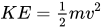
- 1.42×10³ J,一个3.5 g(公克)的子弹被AK-74发射所产生的动能。[12]
- 3.28×10³ J,一个9.33 g NATO步枪的子弹以838m/s发射的动能。[12]
- 3.600×10³ J ≡ 1 W·h(瓦特-小时)。
- 4.184×10³ J,一克的TNT爆炸时产生的能量。
- 4.186×10³ J ≡一卡路里。(大卡)
- 1.7×10⁴ J,新陈代谢一克的糖或蛋白质产生的能量。
- 3.8×10⁴ J,一克的油脂的热量。
- 5.0×10⁴ J,燃烧一克的汽油产生的能量。
106[编辑]
- 1×10⁶ J,一条巧克力条的热量。(质疑:一条巧克力的"重量",不确定性太高)
- 6.3×10⁶ J,营养学建议一位成年女性一天摄取的热量。[來源請求]
- 8.4×10⁶ J,营养学建议一位成年男性一天摄取的热量。[來源請求]
- 1.05×10⁸ J ≈一色姆(Therm)=100000英热单位。
109[编辑]
- 1.5×10⁹ J,一次闪电平均释放的能量。
- 1.95627185×10⁹ J,等于普朗克能量。[13]
- 6.12×10⁹ J ≈ 1 bboe(一桶石油的能量)。[14]
- 4.19×10¹⁰ J ≈1 toe(一顿石油的能量)。[14]
- 5×10¹⁰ J,一个MOBE炸弹所产生的能量。
- 7.2×10¹⁰ J,一辆普通汽车一年的动能。
- 8.64×10¹⁰ J ≈ 1 MW·d(百万瓦-天)
1012[编辑]
- 3.6×10¹³ J,一场暴风雨平均释放的能量。
- 5.5×10¹³ J,小男孩原子弹爆炸时释放的能量。[15]
- 8.78×10¹³ J,胖子原子弹爆炸时释放的能量。[15]
- 9.0×10¹³ J,根据质能转换公式,这等于一克物质的能量。
- 6×10¹⁴ J,一个颱风每秒释放的能量
- 5×10¹⁴ J,一枚現代小型化氫彈爆炸時释放的能量。
1015[编辑]
- 2.07×10¹⁵ J,2005年多哥共和国所消耗的电量。[16]
- 1.0×10¹⁶ J,一个足以造成巴林杰陨石坑小行星撞击产生的能量。
- 4.42×10¹⁶ J,2005年辛巴威所消耗的电量。[16]
- 1.74×10¹⁷ J,每秒太阳释放到地球的热量。[17]
- 2.1×10¹⁷ J,沙皇核弹爆炸时释放的能量。
- 4.10×10¹⁷ J,2005年挪威所消耗的电量。[16]
1018[编辑]
- 3×10¹⁸ J, 中国所消耗的电量。
- 3.5×10¹⁸ J,2018年中国所制造的能量
- 3×10¹⁸ J,颱风平均一天所释放的能量。[18]
- 1.12×10¹⁹ J,2011年日本东北地方太平洋近海地震释放的能量
- 1.12×10¹⁹ J,2004年印度洋大地震释放的能量。
- 2×10¹⁸ J,美国一個月所消耗的电量
- 1.37×10¹⁹ J,2005年美国所消耗的电量
- 1.46×10¹⁹J,2005年美国所生产的电量。[16]
- 3×10¹⁹ J,1960年智利大地震释放的能量。
1021[编辑]
- 6.5×10²¹ J,预估地球上的天然气总共可提供的能量。[19]
- 7.4×10²¹ J,预估地球上的钸总共可提供的能量。
- 3×10²² J,多峇巨灾释放的能量。
- 1.5×10²²J,太阳每天释放到地球的能量。[17]
- 2.1×10²² J,预估地球上的煤总共可提供的能量。[20]
- 3.9×10²² J,预估地球上的石油总共可提供的能量。
- 5.0×10²³ J,一个足以造成希克苏鲁伯陨石坑小行星撞击产生的能量。
1024[编辑]
大于1027[编辑]
- 2×1029 J,月球重力结合能的能量,地球自轉的能量
- 3.34×1031 J,太阳每天释放的能量。[21]
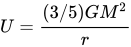
- 2.4×1032 J,地球重力结合能的能量。[22]
- 2.7×1033 J,地球公转的动能。[23]
- 1.22×1034 J,太阳每年释放的能量。[21]
- 5.37×1041 J,根据质能转换公式,这等于一地球质量的能量。
- 1.9×1041 J,太阳重力结合能的能量,类星体能量。
- 1.2×1044 J,超新星爆炸时释放的能量。
- 1×1046 J,,极超新星爆炸时释放的能量。
- 1×1047 J,伽玛射线暴释放的能量。
- 1.8×1047 J,根据质能转换公式,这等于一太阳质量的能量。
- 7.2×1058 J,根据质能转换公式,这等于一银河系质量的能量。(不包括暗物质)
- 7.2×1059 J,根据质能转换公式,这等于一银河系质量的能量。(包括暗物质)
- 1.314×1070 J,根据质能转换公式,这约等于目前可觀測宇宙质量对应的能量。[24]
- ∞ J ,引力奇点的能量。
参考文献[编辑]
- ^ Planck's constant | physics | Britannica.com. britannica.com. [26 December 2016]. (原始内容存档于2015-05-03).
- ^ 存档副本. [2008-01-13]. (原始内容存档于2008-05-09).
- ^ 存档副本. [2008-01-13]. (原始内容存档于2009-04-01).
- ^ 4.0 4.1 存档副本. [2008-01-13]. (原始内容存档于2007-03-09).
- ^ 存档副本 (PDF). [2008-01-13]. (原始内容存档 (PDF)于2019-06-12).
- ^ 存档副本. [2008-01-13]. (原始内容存档于1999-10-12).
- ^ Coin specifications. United States Mint. [2 November 2011]. (原始内容存档于2015-05-15).
11.340 g
- ^ Calculated: m*g*h = 11.34e-3 kg * 9.8 m/s^2 * 1 m = 1.1e-1 J
- ^ http://psroc.phys.ntu.edu.tw/bimonth/v24/538.pdf (PDF). [2008-01-13]. (原始内容存档 (PDF)于2015-12-22). 外部链接存在于
|title=(帮助) - ^ 存档副本 (PDF). [2008-01-13]. (原始内容存档 (PDF)于2015-12-22).
- ^ 存档副本. [2008年1月13日]. (原始内容存档于2018年1月13日).
- ^ 12.0 12.1
- ^
- ^ 14.0 14.1 option=com_content&task=view&id=9 Energy Units (页面存档备份,存于互联网档案馆), by Arthur Smith, 2005年1月21日
- ^ 15.0 15.1 存档副本. [2008-01-13]. (原始内容存档于2017-09-13).
- ^ 16.0 16.1 16.2 16.3 存档副本. [2008-01-13]. (原始内容存档于2008-09-24). from the Energy Information Administration [1] (页面存档备份,存于互联网档案馆)
- ^ 17.0 17.1 引证错误:没有为名为
sun1的参考文献提供内容 - ^ FAQ : HURRICANES, TYPHOONS, AND TROPICAL CYCLONES (页面存档备份,存于互联网档案馆) noaa.gov
- ^ 存档副本. [2012-01-27]. (原始内容存档于2011-05-23). from the Energy Information Administration
- ^ 存档副本. [2010-05-27]. (原始内容存档于2010-01-08). from the Energy Information Administration [2] (页面存档备份,存于互联网档案馆)
- ^ 21.0 21.1 引证错误:没有为名为
sun2的参考文献提供内容 - ^
Chandrasekhar, S. 1939, An Introduction to the Study of Stellar Structure(Chicago: U. of Chicago; reprinted in New York: Dover), section 9, eqs. 90-92, p. 51 (Dover edition)
Lang, K. R. 1980, Astrophysical Formulae(Berlin: Springer Verlag), p. 272 - ^ 存档副本. [2016年12月26日]. (原始内容存档于2017年8月22日).
- ^ Jim Lochner. Big Bang Energy. web.archive.org. 2014-08-19 [2021-09-08]. 原始内容存档于2014-08-19.