

福克-普朗克方程

(重定向自佛客-普朗克方程式)

福克-普朗克方程(Fokker–Planck equation)描述粒子在位能場中受到隨機力後,隨時間演化的位置或是速度的分布函數 [1] 。此方程式以荷蘭物理學家阿德里安·福克[2]與馬克斯·普朗克[3]的姓氏來命名。
一維 x方向上,福克-普朗克方程有兩個參數,一是拖曳參數 D1(x,t),另一是擴散 D2(x,t)
![{\displaystyle {\frac {\partial }{\partial t}}f(x,t)=-{\frac {\partial }{\partial x}}\left[D_{1}(x,t)f(x,t)\right]+{\frac {\partial ^{2}}{\partial x^{2}}}\left[D_{2}(x,t)f(x,t)\right].}](https://wikimedia.org/api/rest_v1/media/math/render/svg/a851f9f8af87ef864a937f4fd0eae85f750c549b)
在 維空間中的福克-普朗克方程是

![{\displaystyle {\frac {\partial f}{\partial t}}=-\sum _{i=1}^{N}{\frac {\partial }{\partial x_{i}}}\left[D_{i}^{1}(x_{1},\ldots ,x_{N})f\right]+\sum _{i=1}^{N}\sum _{j=1}^{N}{\frac {\partial ^{2}}{\partial x_{i}\,\partial x_{j}}}\left[D_{ij}^{2}(x_{1},\ldots ,x_{N})f\right],}](https://wikimedia.org/api/rest_v1/media/math/render/svg/619522eefdacb8073c9d778fe21d3bd0c0285fe0)


其他[编辑]
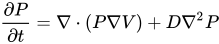
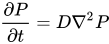
若V=0,则福克-普朗克方程成为布朗运动
與隨機方程式的關係[编辑]
福克-普朗克方程可以用來計算隨機過程裡隨機微分方程式中分布函數的解。
一個受隨機力的古典粒子,經由朗之萬方程式可以得到福克-普朗克方程。另外再藉由福克-普朗克方程也可推導薛丁格方程式[4]。
參考資料[编辑]
- ^ Leo P. Kadanoff. Statistical Physics: statics, dynamics and renormalization. World Scientific. 2000. ISBN 9810237642.
- ^ A. D. Fokker, Die mittlere Energie rotierender elektrischer Dipole im Strahlungsfeld, Ann. Phys. 348 (4. Folge 43), 810–820 (1914).
- ^ M. Planck, Sitz.ber. Preuß. Akad. (1917).
- ^ Edward Nelson ,"Derivation of the Schrödinger Equation from Newtonian Mechanics",Phys. Rev. 150, 1079–1085 (1966)
相關條目[编辑]
延伸閱讀[编辑]
- Hannes Risken, "The Fokker–Planck equation : Methods of Solutions and Applications", 2nd edition, Springer Series in Synergetics, Springer, ISBN 3-540-61530-X.
- David Tong. Kinetic Theory. Ch. 3. https://www.damtp.cam.ac.uk/user/tong/kinetic.html (页面存档备份,存于互联网档案馆)
- Scott. Applied Stochastic Processes.
外部連結[编辑]
- 福克–普朗克方程式 (页面存档备份,存于互联网档案馆) on the Earliest known uses of some of the words of mathematics (页面存档备份,存于互联网档案馆)
