

齊夫定律

|
概率质量函數  横纵坐标均为对数比例下,齐夫定律的概率质量函数的图像,其中N = 10。横坐标是指数k 。(注意,函数仅在k为整数时有定义,图上的连线不代表函数连续。) | |||
|
累積分布函數  横纵坐标均为对数比例下,齐夫定律的累计分布函数的图像,其中N = 10。横坐标是指数k 。(注意,函数仅在k为整数时有定义,图上的连线不代表函数连续。) | |||
| 参数 |
(实数) (正整数) | ||
|---|---|---|---|
| 值域 | |||
| 概率质量函数 | |||
| 累積分布函數 | |||
| 期望值 | |||
| 眾數 | |||
| 熵 | |||
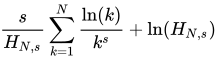
| 矩生成函数 | |||
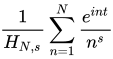
| 特徵函数 | |||






齐夫定律(英語:Zipf's law,IPA/ˈzɪf/)是由哈佛大學的語言學家喬治·金斯利·齊夫于1949年发表的实验定律。它可以表述为:在自然语言的語料庫裡,一个单词出现的频率与它在频率表里的排名成反比。所以,频率最高的单词出现的频率大约是出现频率第二位的单词的2倍,而出现频率第二位的单词则是出现频率第四位的单词的2倍。这个定律被作为任何与冪定律概率分布有关的事物的参考。
例子[编辑]
最简单的齐夫定律的例子是“1/f function”。给出一组齐夫分布的频率,按照从最常见到非常见排列,第二常见的频率是最常见频率的出现次数的½,第三常见的频率是最常见的频率的1/3,第n常见的频率是最常见频率出现次数的1/n。然而,这并不精确,因为所有的项必须出现一个整数次数,一个单词不可能出现2.5次。
在布朗语料库中,“the”、“of”、“and”是出現頻率最前的三個單詞,其出現的頻數分別為69971次、36411次、28852次,大約佔整個語料庫100萬個單詞中的7%、3.6%、2.9%,其比例約為6:3:2。大約佔整個語料庫的7%(100万单词中出现69971次)。满足齐夫定律中的描述。仅仅前135個字彙就佔了Brown語料庫的一半。
齐夫定律是一个实验定律,而非理论定律,可以在很多非语言学排名中被观察到,例如不同国家中城市的数量、公司的规模、收入排名等。但它的起因是一个争论的焦点。齐夫定律很容易用点阵图观察,坐标分别为排名和频率的对数(log)。比如,“the”用上述表述可以描述为x = log(1), y = log(69971)的点。如果所有的点接近一条直线,那么它就遵循齐夫定律。
遵循该定律的现象[编辑]
參見[编辑]
延伸閱讀[编辑]
主要:
- George K. Zipf(1949)Human Behavior and the Principle of Least Effort. Addison-Wesley.
- George K. Zipf (1935) The Psychobiology of Language. Houghton-Mifflin.(see citations at http://citeseer.ist.psu.edu/context/64879/0)
次要:
- Lada Adamic. Zipf, Power-laws, and Pareto - a ranking tutorial. http://www.hpl.hp.com/research/idl/papers/ranking/ranking.html(页面存档备份,存于互联网档案馆)
- Alexander Gelbukh and Grigori Sidorov (2001) "Zipf and Heaps Laws’ Coefficients Depend on Language" (页面存档备份,存于互联网档案馆). Proc. CICLing-2001, Conference on Intelligent Text Processing and Computational Linguistics, February 18–24, 2001, Mexico City. Lecture Notes in Computer Science N 2004, ISSN 0302-9743, ISBN 3-540-41687-0, Springer-Verlag: 332–335.
- Damián H. Zanette (2006) "Zipf's law and the creation of musical context," Musicae Scientiae 10: 3-18.
- Kali R. (2003) "The city as a giant component: a random graph approach to Zipf's law," Applied Economics Letters 10: 717-720(4)
- Gabaix, Xavier. Zipf's Law for Cities: An Explanation (PDF). Quarterly Journal of Economics. August 1999, 114 (3): 739–67 [2014-02-05]. ISSN 0033-5533. doi:10.1162/003355399556133. (原始内容存档 (PDF)于2021-02-24).
- Axtell, Robert L; Zipf distribution of US firm sizes (页面存档备份,存于互联网档案馆), Science, 293, 5536, 1818, 2001, American Association for the Advancement of Science
外部連結[编辑]

- Steven, Strogatz. Guest Column: Math and the City. The New York Times. 2009-05-29 [2009-05-29]. (原始内容存档于2015-09-27).—An article on Zipf's law applied to city populations
- Seeing Around Corners (Artificial societies turn up Zipf's law) (页面存档备份,存于互联网档案馆)
- PlanetMath article on Zipf's law(页面存档备份,存于互联网档案馆)
- Distributions de type "fractal parabolique" dans la Nature (French, with English summary)(页面存档备份,存于互联网档案馆)
- An analysis of income distribution (页面存档备份,存于互联网档案馆)
- Zipf List of French words
- Zipf list for English, French, Spanish, Italian, Swedish, Icelandic, Latin, Portuguese and Finnish from Gutenberg Project and online calculator to rank words in texts
- Citations and the Zipf–Mandelbrot's law (页面存档备份,存于互联网档案馆)
- Zipf's Law for U.S. Cities (页面存档备份,存于互联网档案馆) by Fiona Maclachlan, Wolfram Demonstrations Project.
- 埃里克·韦斯坦因. Zipf's Law. MathWorld.
- Zipf's Law examples and modelling (1985)
- Complex systems: Unzipping Zipf's law (2011) (页面存档备份,存于互联网档案馆)
- Benford’s law, Zipf’s law, and the Pareto distribution (页面存档备份,存于互联网档案馆) by Terence Tao.


|
